A Guide to Container Security Tools for 2024
At a high level, all container security tools do the same basic thing: They help to identify and mitigate security risks in container-based applications and environments. But exactly how they do this, and the specific types of container security features the tools offer, can vary widely.
With that reality in mind, here’s an overview of what to consider when selecting container security tools, along with a look at the main types of solutions available as of 2024.
In this article:
- What are container security tools?
- The importance of container security tools
- 7 key types of container security tools
- Aqua: Your comprehensive container security solution
What are container security tools?
Container security tools are software designed to identify, assess and/or mitigate security risks in container-based applications. In addition, many container security solutions can help address risks in software that is commonly used alongside containers – such as the Kubernetes orchestrator or container registries.
Again, the specific types of risks that container security solutions address, and the way they address them, can vary – so it’s important not to assume that all tools in this category do exactly the same thing, or that all types of security risks involving containers are the same. To provide context on this topic, we’ll dive deeper into different types of security risks and features later in this article.
The importance of container security tools
Container-based applications present a number of unique security challenges that don’t typically exist in other types of environments, such as those that consist of monolithic applications hosted directly on physical or virtual servers.
Examples of special security risks that apply to containers include:
- A broader attack surface to manage due to the many components – container images, registries, runtimes, orchestrators and so on – that are typically used to deploy containerized apps.
- The need to monitor and secure a larger number of application components because containerized apps often consist of multiple microservices.
- Lack of rigid isolation between containerized applications and the host server, which increases the chances that a security risk inside a container could “spill over” to affect other containers or the host.
- A large number of network connections, including both the internal networks that containers use to talk among themselves and the public-facing networks they use to handle external requests. More network communication and complexity increases risks like “sniffing” of unencrypted sensitive data as it moves across the network.
Because these security challenges don’t usually exist in other types of environments, addressing them requires tools purpose-built for securing containers and related software. Attempting to graft traditional security solutions onto a containerized environment simply doesn’t work well because traditional tools are not designed to handle the special risks that apply to containers.
Security teams are flooded with alerts, but lack the context needed to act decisively, especially in runtime. The Container Security Risk Assessment (CSRA) brings that context to the forefront. It’s fast, insightful, and actionable, and it represents a commitment to helping organizations stay ahead of emerging threats.
7 key types of container security tools
Broadly speaking, container security solutions available today can be broken down into the following seven categories.
Note that in many cases, a single tool spans multiple categories; it’s not as if you need to purchase a separate solution to gain each of the capabilities discussed below. That said, thinking about container security based on the tool types discussed below is the best way to ensure you obtain solutions capable of delivering all of the protections you need.
#1. Container scanning tools
Container scanning tools (also sometimes called Docker image scanners or Docker vulnerability scanners) analyze container images to look for security vulnerabilities inside them. Some scanners can also identify risks beyond vulnerabilities, such as configuration oversights that could expose a container to attack.
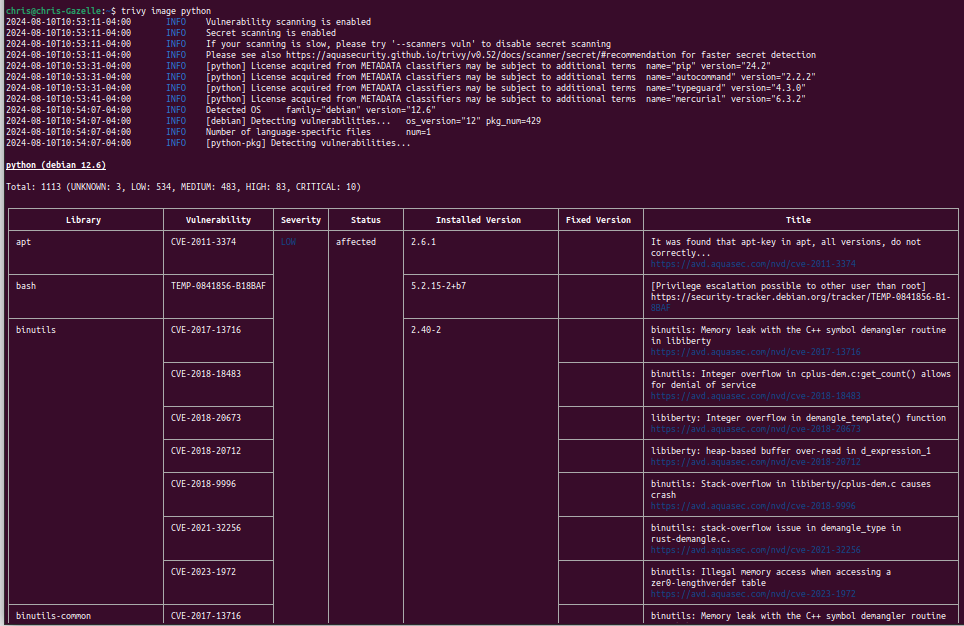
For example, the Trivy vulnerability scanner from Aqua can automatically scan both local images (meaning those stored in a local file system) and images hosted in popular registries, like Docker Hub. Trivy then generates a list of vulnerabilities and risks inside container images, along with information to help teams understand and fix each one.
For instance, here are partial results from scanning the Python container image in Docker Hub:
#2. Container runtime security
Container runtimes are the software that executes containers. They can be subject to security flaws due to bugs in runtime source code that enable attacks using methods like buffer overflows or code injection. Scanning for vulnerabilities in runtime software as part of supply chain security controls helps to identify and address these risks.
#3. Container security monitoring
In the realm of containers, security monitoring means watching what happens in live container environments. Typically, the goal of monitoring is to identify anomalies – such as unusual types of requests or sudden spikes in CPU and memory consumption that can’t be explained by a legitimate change in workload requirements – that could be a sign of attack.
#4. Container registry security
Container registries host container images. Security flaws in registry software could lead to issues like unauthorized access to images, allowing attackers to upload images containing malware.
To protect against this risk, some container security solutions can analyze registry configurations. In addition, scanning images inside registries helps to detect images that might have been manipulated by malicious actors.
#5. Orchestrator security
Orchestrators are tools responsible for scheduling and managing containers that run across a cluster of servers. Modern orchestrators like Kubernetes are complex and can be subject to a variety of security issues – from insecure Role-Based Access Control (RBAC) settings, to vulnerabilities in node operating systems, to vulnerabilities in orchestrators themselves.
Addressing these risks requires tools that can comprehensively scan orchestrator configurations, as well as monitor running environments to identify unusual activity.
#6. Container secrets management
Secrets management is the practice of securing sensitive information, like passwords and API keys. Some container security tools can help to identify secrets that are managed in insecure ways as part of containerized application deployments – such as passwords that are hard-coded in container images, and are therefore easily visible to anyone who is able to access the images.
#7. Container network security
Securing the networks that connect containers requires the enforcement of secure network configurations, as well as detecting and blocking malicious activity. Analyzing network configurations in containers and orchestrators are part of this process. Tools like service meshes, which can monitor internal traffic, and API gateways, which help manage external traffic, can also help.
Aqua: Your comprehensive container security solution
As a unified cloud security platform, Aqua provides all of the core capabilities organizations need to secure containers and beyond. From identifying risks in applications and container images, to identify insecure orchestrator configurations, to managing runtime risks, Aqua has you covered.
Aqua Cloud Native Application Protection Platform (CNAPP)
Go cloud native with the experts!