- Cloud Native Applications
- Application Security
- Web Application Security
- Application Security Posture Management (ASPM)
- Microsegmentation
- Python Security
- SaaS Security
- Node.JS Security
- PHP Security
- AI in Cyber Security
- Cybersecurity for Financial Services
- The Principle of Least Privilege (PoLP)
- Identity and Access Management
- Cybersecurity in Banking
- Threat Detection and Response
- Cyber Kill Chain
- Threat Hunting
- Zero Trust Security
- Zero Trust Architecture
- Fileless Attacks
- DSPM
- Container Scanning
- Kubernetes
- Kubernetes
- Kubernetes Alternatives
- Kubernetes Namespace
- Kubernetes Architecture
- Kubernetes Cluster
- Kubernetes Nodes
- Kubernetes Pods
- Kubernetes Jobs
- Kubernetes Workloads
- Kubernetes Monitoring
- Kubernetes Security
- Kubernetes RBAC
- Secret Scanning
- Kubernetes Security Posture Management (KSPM)
- Kubernetes on AWS
- Kubernetes on VMware
- Kubernetes Vulnerability Scanning
- Managing Containers in Kubernetes
- K3s
- eBPF in Kubernetes
- Kubernetes Dashboard
- Kubernetes Operators
- Kubernetes Services
- Kubernetes Devops
- Kubernetes Networking
- Kubernetes ConfigMap
- Kubernetes Management
- Kubernetes Helm
- Kubernetes as a Service
- Kubernetes Serverless
- Kubernetes Tutorials
- Cloud Attacks
- Cloud Attacks
- Malware Attacks
- Zero Day Attack
- Top 10 Cyber Security Threats
- Arbitrary Code Execution
- Cryptojacking
- AI Attacks
- Prompt Injection
- Backdoor Attacks
- Reverse Shell Attack
- Remote Code Execution
- Defense Evasion
- Honeypots in Cybersecurity
- Malware Analysis
- AI Malware
- Lateral Movement
- Advanced Malware Protection
- CNAPP
- AI Security
- Container Platforms
- Containerized Architecture
- Docker Secrets
- Container Runtime Interface
- Container Images
- Image Scanning
- Container Compliance
- Docker Security Best Practices
- Container Security
- Container Security Best Practices
- Container Security Tools
- ECS Security
- Network Segmentation
- Istio security
- runC
- Service Mesh
- Image Repository
- Container Escape
- Container Runtime
- Docker Container
- OSS Container Image Scanning Tools
- What Is a Container?
- Docker Images
- Containerization 101
- VM vs. Container
- Containerization vs. Virtualization
- Containerized Applications
- Microservices and Containerization
- Registry Scanning
- Docker CVEs
- Docker Monitoring
- Securing Containers with Docker Scanning
- Docker CIS Benchmark
- Seccomp
- Docker Alpine
- Docker API
- Docker Tools
- 100 Best Docker Tutorials
- Docker Alternatives
- Docker Swarm
- Docker Containers vs. Virtual Machines (VMs)
- Docker Architecture
- Docker Networking
- Docker Registries
- Docker Orchestration
- OpenShift vs Docker
- Container Cloud Computing
- Container DevOps
- Docker in Production
- Container Monitoring
- Container Advantages
- Docker Hub
- Serverless Architecture
- Supply Chain Security
- Supply Chain Compliance
- SolarWinds Attack
- Supply Chain Security
- Secure Software Development Lifecycle
- Software Supply Chain Attacks
- Dependency Confusion Attack
- SLSA
- SSDF
- Software Composition Analysis
- Security Misconfigurations
- Repojacking
- Privilege Escalation
- CI/CD Security
- SAST Security
- GitLab Security
- GitHub Secret Scanning
- OWASP Dependency-Check
- Software Bill of Materials
- SBOM Tools
- NPM Vulnerabilities
- Log4j Vulnerability
- Text4Shell
- Secrets Management
- Jenkins Security
- Yarn vs. NPM
- Source Code Leaks
- Container Image Signing
- Open Source Licenses
- Vulnerability Management
- Vulnerability Management Tools
- Vulnerability Scanning Process
- Vulnerability Management
- Vulnerability Scanning
- Vulnerability Prioritization
- Open Source Vulnerability Scanning
- Vulnerability Remediation
- Vulnerability Scanner
- Risk-Based Vulnerability Management
- Vulnerability Exploitability eXchange (VEX)
- Malware Detection
- Fileless Malware
- Attack Vectors
- Malicious Code
- Risk Posture
- Alert Fatigue in Cybersecurity
- Cyber Security Posture
- MITRE ATT&CK
- MITRE ATT&CK Framework
- LLM Security
- Code Scanning
- Attack Surface
- Attack Surface Management
- What Are Indicators of Compromise (IoC)?
- Secure Code
- Configuration Drift
- Trivy
- DevSecOps
- DevSecOps
- DevSecOps Pipeline
- DevSecOps Best Practices
- DevSecOps vs SecDevOps
- Threat Modeling
- Mean Time to Repair (MTTR)
- eBPF Linux
- Cloud DevOps
- DevOps Tools
- GitOps vs DevOps
- Code Security
- Secure Code Review
- DevOps Security
- Infrastructure as Code (IaC) Security
- Infrastructure as Code DevOps
- Executive Order 14028 (U.S. Cybersecurity Executive Order)
- Open Source Security
- Shift-Left Security
- Shift Right Testing and Security
- What Is SecOps (Security Operations)?
- SecDevOps
- DevSecOps Tools
- Linux Security
- Rocky Linux
- Azure DevOps
- Cloud Security
- Cloud Security
- Cloud Security Challenges
- Cloud Security Tools
- Code to Cloud
- Cloud Protection
- Cloud Security Frameworks
- Cloud Security Standards
- Cloud Security Controls
- Cloud Security Posture Management (CSPM)
- AI Workloads
- Cloud Digital Forensics
- Cloud Computing Security Architecture
- What Is Enterprise Cloud Security?
- Virtualized Security
- CSPM Tools
- Vulnerabilities in Cloud Computing
- Top 7 Risks of Cloud Computing
- Cloud Security Assessment
- Cloud Visibility
- Cloud Governance
- Cloud Security Strategy
- Cloud Security Policy
- DFIR
- Cloud Workloads
- Public Cloud Security
- Private Cloud vs. Public Cloud
- Runtime Security
- Azure Cloud Security
- Azure Security Best Practices
- Azure Security vs. AWS Security
- AWS GovCloud: Basics & How It Compares to Azure & GCP
- S3 Security
- Cloud Misconfiguration
- Terraform Security
- Hybrid Cloud Security
- Multi-Cloud Strategy
- Agentless vs. Agent-Based Security & Monitoring
- Cloud Infrastructure Security
- Gartner CSPM
- Cloud Security Scanner
- AWS CIS Benchmark
- Cloud Configuration Management
- Cloud Workload Protection (CWP)
- Cloud Workload Protection Platforms (CWPP)
- Cloud Workload Security
- Cloud Vulnerabilities and Tools that Can Help
- Google Cloud Security
- Shared Responsibility Model
- AWS Shared Responsibility Model
- AWS Cloud Security
- Multi Cloud Security
- Cloud Compliance
- Kubernetes in Production
- Cloud Detection And Response
Agentless vs. Agent Based Security & Monitoring: How to Choose?
Agentless refers to a technology or approach that operates without requiring the installation of additional software agents or components on the target systems or devices.
What Is Agentless?
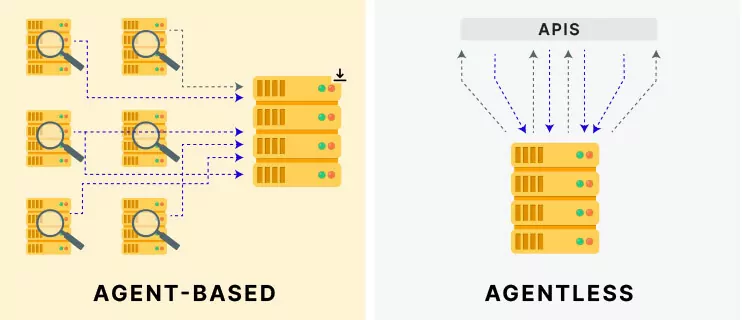
Agentless refers to a technology or approach that operates without requiring the installation of additional software agents or components on the target systems or devices. Agentless architectures are commonly used to deploy security or monitoring systems across distributed systems. This is typically achieved through utilizing remote management protocols or APIs, allowing the management system to access and control the target system remotely.
The advantage of agentless technology is that it can be simpler to implement and maintain, as there is no need to install and manage agents on each device. Additionally, it can also be more secure, as there are fewer components that could potentially introduce vulnerabilities into the system. However, agentless systems have many limitations, including limited real-time monitoring, reduced level of detail, dependency on APIs, and limited automation.
This is part of a series of articles about cloud security.
In this article:
What Is Agentless Security and Monitoring?
Agentless security and monitoring refer to a method of collecting and analyzing security-related information about an environment and its workloads without deploying additional software agents or components. Instead, information is gathered using non-invasive methods, such as through cloud APIs or by processing log files.
Agentless scans take snapshots of resources, assessing the environment through API calls to gather metadata and runtime storage information from the workloads. This information is then processed with machine learning algorithms to build an inventory and analyze the security risks across the environment.
This approach to security and monitoring offers the advantage of low friction, allowing security teams to assess risk and maturity without having to deploy software into the environment. Additionally, because no code is deployed on the workloads, it can also be seen as a more secure and less intrusive method of security monitoring.
Limitations of the Agentless Approach
However, agentless security has some limitations that organizations should be aware of when considering this approach:
- Limited real-time monitoring: Since agentless security relies on non-invasive methods such as cloud APIs or log files, it may not provide real-time monitoring capabilities in the same way that agent-based security does.
- Reduced level of detail: Agentless security may also provide a reduced level of detail compared to agent-based security, as it cannot collect information at the same level of granularity.
- Dependence on APIs and log files: Agentless security relies on the availability and accuracy of APIs and log files, which may not be accessible or up-to-date in all environments.
- Limited Automation: Because agentless security does not have direct access to the devices, it may be more difficult to automate security policies and controls in the same way that agent-based security can.
- Compatibility issues: In some cases, the APIs or log files used by agentless security may not be compatible with all devices or systems, which could limit the scope of the security information that can be collected.
It’s important to carefully consider the limitations of agentless security and weigh them against the specific requirements and priorities of the organization before deciding on this approach.
Agentless vs. Agent-Based Security
Agent-based security refers to a method of collecting and analyzing security-related information about an environment and its workloads by deploying software agents on each device or system. The agents continuously monitor and report back security-related data to a central management system.
Pros of agent-based security:
- Provides real-time monitoring and reporting of security-related data.
- Offers more granular and detailed information about the state of the environment and its workloads.
- Can automate and enforce security policies and controls directly on the devices.
- Can be more efficient and effective in detecting and responding to security incidents.
Cons of agent-based security:
- Adds additional software components to the environment, which could introduce vulnerabilities or performance issues.
- Requires additional resources and effort to deploy and maintain the agents on each device.
- Might negatively impact the performance of the devices.
Key differences between agentless and agent-based security:
| Agentless Security | Agent-Based Security | |
| Deployment | No agents or components installed on devices | Software agents deployed on each device or system |
| Data Collection | Non-invasive methods (e.g. APIs, log files) | Agents continuously monitor and report back data |
| Real-time Monitoring | Limited | More detailed and real-time |
| Security | Considered more secure and less intrusive | Potentially less secure due to additional components installed |
| Maintenance | Generally easier to maintain | Requires additional effort to deploy and maintain agents |
| Performance Impact | Generally less intrusive | Potential performance impact on the devices |
| Detail | Limited information and detail | More granular information and detail |
Agent Security vs. Agentless Security: How to Choose?
When choosing between agent security and agentless security, there are several factors to consider:
- Visibility and control: Agent based systems provide a higher level of visibility over endpoint devices and systems.
- Control: An agent-based solution provides more control, can be used to proactively enforce security policies, and keep systems up-to-date with the latest security patches.
- Scalability: Agentless security solutions may be more scalable than agent-based solutions, as they do not require additional software to be installed on each device or system. This can be beneficial in large, distributed environments where managing and maintaining agents on a large number of devices would be challenging.
- Integration: Agent-based solutions may be more easily integrated with other security solutions and systems, as they can provide detailed information about the state of a device or system.
- Resource usage: Agent-based solutions can consume more resources on the endpoint, such as memory and CPU, than agentless solutions. In environments where devices have limited resources, agentless solutions may be more suitable.
- Use case: The specific use case or environment will also play a role in determining which type of solution is more suitable. For example, in environments where devices are not easily accessible, such as in industrial control systems, agentless solutions may be more suitable.
It’s important to evaluate the specific needs and requirements of your organization and to consider the trade-offs between the two types of solutions. It’s also important to note that it’s not an either-or decision, and a combination of both agent and agentless security solutions can also be used to provide a more comprehensive security posture.
Learn more About Vulnerability Management
Open Source Vulnerability Scanning: Methods and Top 5 Tools
Open source vulnerability scanners, often used as part of Software Composition Analysis (SCA) tools, are used to detect open source components used in software projects, and check if they contain unpatched security vulnerabilities, and help organizations remediate them. These tools scan complex dependency trees, because vulnerabilities can be found in a dependent library used by the main component or brought into an application during the build phase. Learn how open source vulnerability scanning works and discover tools that can help you identify and remediate vulnerabilities in OSS components and containers.
Read more: Open Source Vulnerability Scanning: Methods and Top 5 Tools
Trivy Vulnerability Scanner Adopted by Leading Cloud Native Platforms
Trivy is a comprehensive and easy-to-use open source vulnerability scanner for container images. Unlike other open source scanners, Trivy covers both OS packages and language-specific dependencies and is extremely easy to integrate into organizations’ software development pipelines. Trivy vulnerability scanner is being added as an integrated option in the CNCF’s Harbor registry, in GitLab, and in Mirantis Docker Enterprise.
Read more: Trivy Vulnerability Scanner Adopted by Leading Cloud Native Platforms
- 7 Dimensions of Cloud Security, Top 10 Risks and How to Defend
- Top 7 Cloud Security Challenges and How to Overcome Them
- Cloud Security Tools
- What Is Code to Cloud Security?
- Cloud Protection: Why, How & 6 Essential Technologies
- Cloud Security Frameworks
- 10 Cloud Security Standards You Must Know About
- Cloud Security Controls
- What Is Cloud Security Posture Management (CSPM)?
- What Are AI Workloads?
- What Is Cloud Computing Forensics?
- Cloud Computing Security Architecture: 5 Key Components
- What Is Enterprise Cloud Security?
- Why Is Security Important for Virtual Machines and Other Virtualized Resources?
- CSPM Tools: Going Beyond Cloud Vendor CSPM Solutions
- Top 5 Threats & Vulnerabilities in Cloud Computing
- How Secure Is Cloud Computing?
- Cloud Security Assessment: 8-Step Process and Checklist
- Cloud Visibility
- 3 Pillars of Cloud Governance, Challenges & Best Practices
- Building a Cloud Security Strategy in 2023
- 9 Key Components of a Cloud Security Policy
- DFIR (Digital Forensics and Incident Response)?
- Cloud Workloads: Types, Common Tasks, and Security Best Practices
- Public Cloud Security: The Basics & 7 Ways to Secure Your Cloud
- Private Cloud vs. Public Cloud: 7 Key Differences and How to Choose
- Why Runtime Security is Essential to Cloud Security
- Azure Cloud Security: An Introduction
- 8 Critical Azure Security Best Practices
- Azure Security vs. AWS Security
- AWS GovCloud: Basics & How It Compares to Azure & GCP
- S3 Security: Build-In Security Features and 4 Critical Best Practices
- What Is Cloud Misconfiguration?
- Terraform Security
- What is Hybrid Cloud Security?
- Multi-Cloud Strategy: Why It’s Critical and 4 Challenges to Address
- Cloud Infrastructure Security: Securing the 7 Key Components
- How Gartner Defines CSPM and 3 Tips for Success
- Cloud Security Scanner: What do Amazon, Azure and GCP Provide?
- What Is the AWS CIS Benchmark?
- Cloud Configuration Management
- Understanding Cloud Workload Protection (CWP)
- What Is a Cloud Workload Protection Platform (CWPP)?
- Cloud Workload Security: Risks, Controls, and 10 Best Practices
- Top 6 Cloud Vulnerabilities and Tools that Can Help
- Google Cloud Security: How It Works and 10 Security Best Practices
- Cloud Shared Responsibility Model: Examples & Best Practices
- What Is the AWS Shared Responsibility Model?
- AWS Cloud Security: The Complete Guide
- What Is Multi-Cloud Security?
- Show more
Aqua Cloud Native Application Protection Platform (CNAPP)
Go cloud native with the experts!