Cloud Security Tools
What Are Cloud Security Tools?
Cloud security tools are specialized software solutions designed to protect and secure data, applications, and infrastructure associated with cloud computing. These tools address a variety of security concerns such as data privacy, unauthorized access, and cloud service vulnerabilities. By deploying these security measures, organizations can safeguard their cloud environments from potential threats and ensure that their operations remain compliant with regulatory and industry standards.
These tools operate across different service models—Infrastructure as a Service (IaaS), Platform as a Service (PaaS), and Software as a Service (SaaS)—and can be utilized in public, private, or hybrid cloud setups. Their functionality encompasses a wide range of tasks, including identity and access management, vulnerability detection and remediation, data encryption, threat detection, and more. Through continuous monitoring and real-time protection, cloud security tools play a critical role in maintaining the integrity and confidentiality of cloud-based systems.
In this article:
Types of Cloud Computing Security Tools
There are many cloud security solutions available, and here are some of the main categories.
1. CSPM (Cloud Security Posture Management)
CSPM tools automate the identification and remediation of risks across cloud infrastructures. They provide continuous monitoring and compliance checks, helping organizations to maintain a secure cloud posture. CSPM tools scan cloud environments for misconfigurations and compliance violations, offering insights into security weaknesses.
These tools help in enforcing security policies and ensuring best practices in cloud deployments. By offering a centralized view of the cloud security posture, CSPM enables proactive risk management.
2. CWPP (Cloud Workload Protection Platform)
CWPP solutions focus on securing workloads across diverse cloud environments. They protect both host and containerized applications against threats, ensuring the security of cloud-based applications and services. CWPP tools offer runtime protection, vulnerability management, and network segmentation features. The adaptability of CWPP solutions makes them suitable for hybrid and multi-cloud architectures.
3. CASB (Cloud Access Security Broker)
CASBs act as intermediaries between users and cloud service providers, enforcing organizational security policies. They offer visibility into cloud application usage, assess security risks, and control data access. CASB solutions support a variety of security measures, including encryption, access control, and threat prevention.
These tools are useful for managing cloud access in a secure manner, especially in environments where BYOD (Bring Your Own Device) policies are implemented. CASBs help align cloud usage with security policies, mitigating the risk of data leakage and unauthorized access.
4. CDR (Cloud Detection and Response)
CDR tools specialize in detecting and responding to threats within cloud environments. They leverage advanced analytics and threat intelligence to identify suspicious activities, providing real-time alerts and automated responses. CDR solutions enable the swift remediation of threats, minimizing their impact on cloud resources.
By continuously analyzing cloud activities, CDR tools also play a vital role in the incident response process, ensuring that security teams can quickly address vulnerabilities and attacks.
5. CIEM (Cloud Infrastructure Entitlement Management)
CIEM solutions manage access entitlements and permissions in cloud environments, preventing excessive privileges and access rights. They help organizations enforce the principle of least privilege, reducing the risk of unauthorized access and data breaches. CIEM tools offer insights into permission configurations and user activities, enabling better control over cloud resources.
7. DSPM (Data Security Posture Management)
DSPM tools are used for monitoring and securing data across cloud environments. They focus on identifying and mitigating risks related to data storage, access, and transfer in cloud platforms. By continuously analyzing data security postures, DSPM solutions help organizations detect misconfigurations, enforce data protection policies, and ensure compliance with data governance standards.
These tools also provide visibility into where sensitive data is stored, how it is accessed, and by whom, making it easier to manage compliance. DSPM tools also support automated remediation processes, which can quickly rectify detected vulnerabilities, reducing the risk of data exposure.
8. API Security
API security refers to the practices and technologies used to protect APIs from being exploited by malicious actors. As APIs facilitate the connectivity between different software applications and services, especially in cloud environments, securing them is essential to prevent data breaches and ensure the integrity of software interactions.
API security tools typically offer features like authentication, authorization, traffic management, and threat detection. They monitor API traffic to detect and block potentially harmful activities, such as unauthorized access or data exfiltration. These tools also ensure that APIs comply with organizational security policies.
Related content: Read our guide to cloud security solutions
CNAPP (Cloud-Native Application Protection Platform): A Holistic Platform for Cloud Security
Cloud-Native Application Protection Platforms offer a unified security model essential for managing the complex security needs of cloud-native applications. These platforms integrate key security technologies—Cloud Security Posture Management (CSPM), Cloud Workload Protection Platforms (CWPP), Cloud Access Security Brokers (CASB), and others—into a single solution.
This integration enables a streamlined approach to securing applications throughout their lifecycle, from development through deployment and operation. By consolidating these functions, CNAPPs eliminate the gaps that might exist between separate tools, ensuring comprehensive coverage and continuous protection.
Adopting CNAPP has several advantages, especially in enhancing real-time threat detection and improving regulatory compliance across multiple cloud environments. With its ability to monitor and manage security across diverse platforms, CNAPP helps organizations maintain a consistent security posture even when deploying complex cloud-native technologies like containers and microservices.
CNAPPs are particularly beneficial in DevOps environments, as they can seamlessly integrate into CI/CD pipelines to assess and mitigate risks early in the development stages. CNAPPs’ ability to automate and orchestrate incident responses helps minimize the impact of security threats.
Notable Open Source Cloud Computing Security Tools
1. Trivy

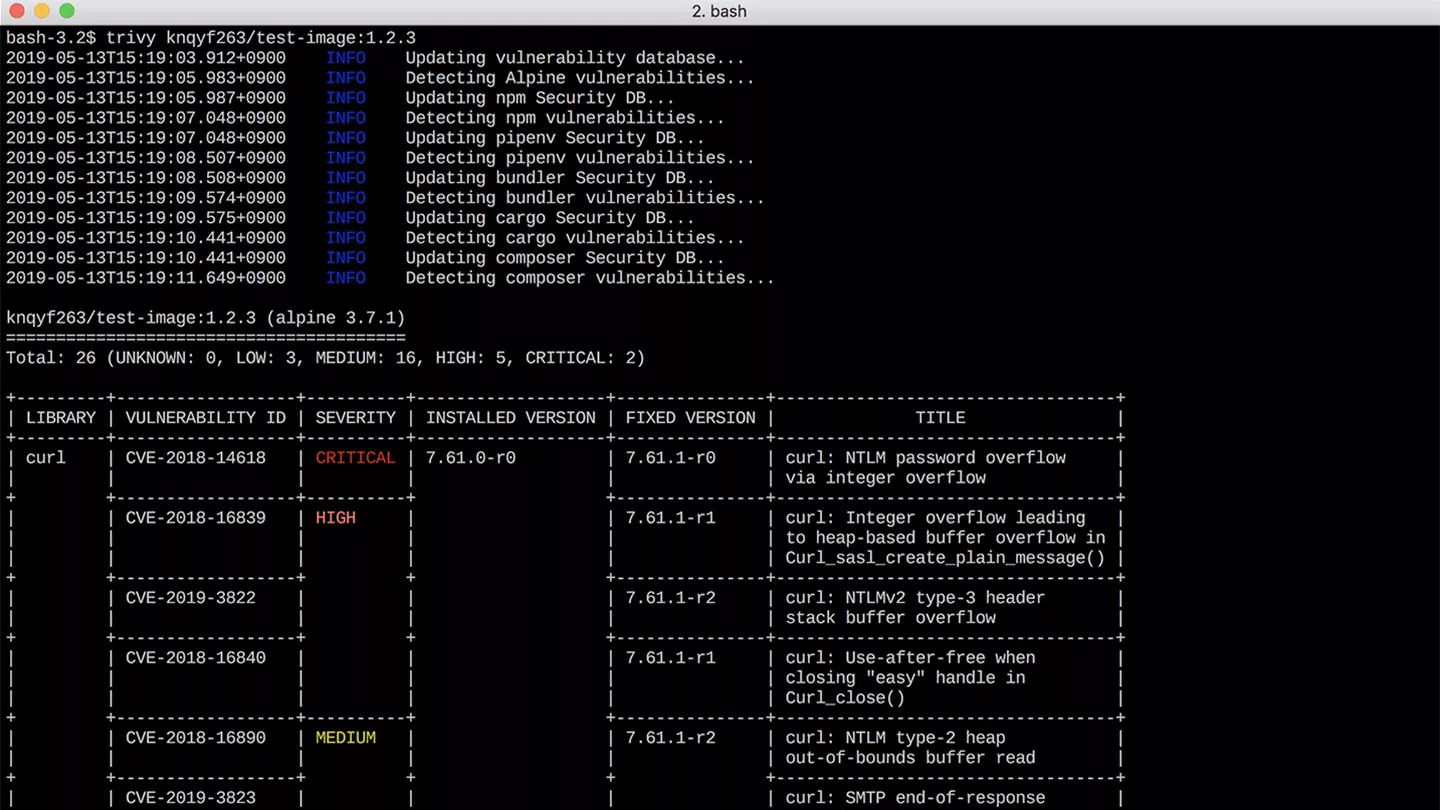
Trivy by Aqua is a versatile security scanner designed to identify security issues across various targets. It is engineered to scan container images, filesystems, remote Git repositories, virtual machine images, Kubernetes configurations, and AWS environments. Its versatility allows it to detect a wide range of security vulnerabilities and misconfigurations.
Key features of Trivy:
- Targets container images, filesystems, remote Git repositories, virtual machine images, Kubernetes, and AWS for scanning.
- Identifies OS packages and software dependencies in use (SBOM), known vulnerabilities (CVEs), Infrastructure as Code (IaC) issues and misconfigurations, sensitive information and secrets, and software licenses.
- Supports most popular programming languages, operating systems, and platforms, showcasing comprehensive scanning coverage.
- Offers quick start options through common distribution channels like Homebrew, Docker, and direct binary downloads from GitHub, facilitating easy installation.
- Integrates with popular platforms and applications, including GitHub Actions, Kubernetes operator, and a Visual Studio Code plugin, demonstrating its adaptability to various development environments.
- Provides canary builds for users interested in the latest features, with the caveat that these may contain critical bugs and are not recommended for production use.

Source: Aqua
2. CloudSploit
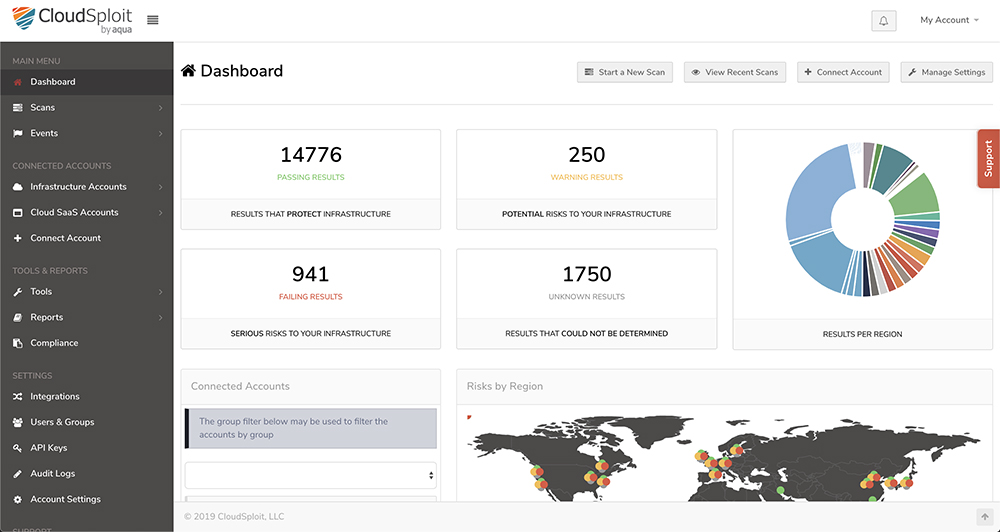
CloudSploit by Aqua is an open-source project geared towards detecting security vulnerabilities within cloud infrastructure accounts. It supports a wide array of cloud environments, including Amazon Web Services (AWS), Microsoft Azure, Google Cloud Platform (GCP), Oracle Cloud Infrastructure (OCI), and GitHub. CloudSploit is designed to uncover potential misconfigurations and security risks, aiding in the reinforcement of cloud security postures.
Key features of CloudSploit:
- Supports multiple cloud platforms, including Amazon Web Services (AWS), Microsoft Azure, Google Cloud Platform (GCP), Oracle Cloud Infrastructure (OCI), and GitHub.
- Offers self-hosted and Aqua Wave hosted deployment options, providing flexibility in how CloudSploit is utilized within organizations.
- Requires read-only access to cloud accounts to detect security vulnerabilities, ensuring non-intrusive operation.
- Allows configuration via a CloudSploit config file, credential files, or environment variables, facilitating seamless integration with existing cloud setups.
- Features a range of CLI options for customized scanning, including support for AWS GovCloud and China, as well as options for ignoring passing results, changing output formats, and setting exit codes for CI/CD integration.
- Supports compliance scans for HIPAA, PCI, and CIS Benchmarks, aligning with industry-standard compliance requirements and enhancing regulatory compliance efforts.
- Provides multiple output formats (Console Output, CSV, JSON, JUnit XML) for easy integration with other tools and for facilitating comprehensive security analysis and reporting.
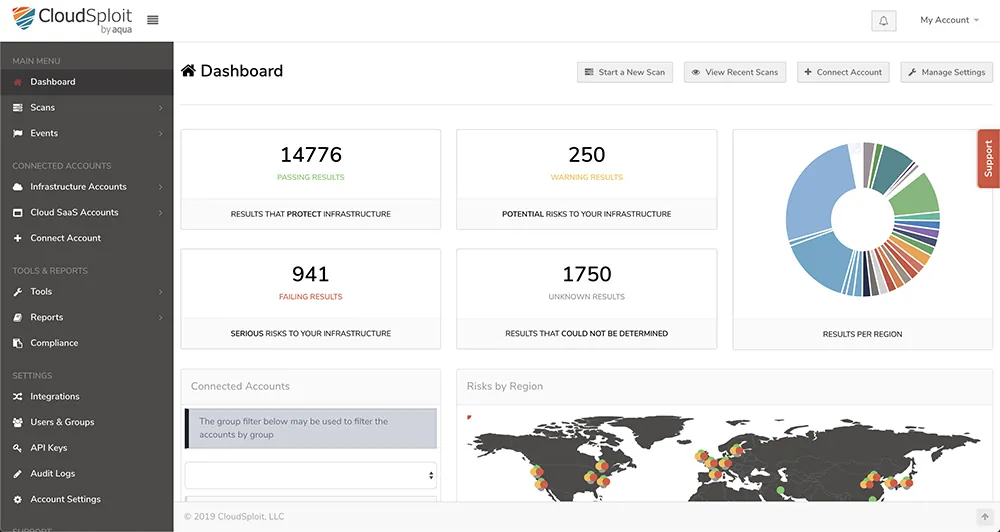
Source: Aqua
3. CloudMapper
CloudMapper is a tool designed for analyzing Amazon Web Services (AWS) environments. Initially developed to generate and display network diagrams, CloudMapper now includes a range of functionalities aimed at auditing for security issues within AWS. Its capabilities extend beyond visualization, offering auditing tools to identify and rectify security misconfigurations and risks.
Key features of CloudMapper:
- Primarily focuses on AWS environments, providing detailed insights into network configurations and potential security vulnerabilities.
- Offers functionalities like auditing for security issues, metadata collection, identification of admin users and roles, detection of unused resources, and finding public hosts and port ranges.
- Includes commands like audit for checking potential misconfigurations, collect for gathering metadata, find_admins to pinpoint admin users, find_unused to detect unused resources, and report to generate HTML reports summarizing account audits and IAM information.
- Supports installation on both macOS and Linux, requiring python 3, pip, virtualenv, jq, and pyjq, ensuring wide accessibility and ease of setup for users across different operating systems.
- Offers further customization through the creation of private commands, allowing users to tailor the tool’s functionality to their specific needs and security policies.
4. OSSEC

OSSEC is a platform for system monitoring and control, integrating the functionalities of HIDS (host-based intrusion detection), log monitoring, and SIM/SIEM into a single open-source solution. It offers a holistic approach to security, aiming to provide an extensive range of monitoring capabilities across various system aspects.
Key features of OSSEC:
- Combines HIDS, log monitoring, and SIM/SIEM capabilities, offering a multifaceted approach to system security and monitoring.
- Features File Integrity Monitoring (FIM) and Attack Detection, including specific scenarios like SSH Brute Force attacks, showcasing its versatility in detecting and responding to various security threats.
- Offers community support through channels like Slack and Discord.
- Development is ongoing with the latest version hosted on GitHub, highlighting an active community and continuous improvements to the platform.
5. OpenVAS

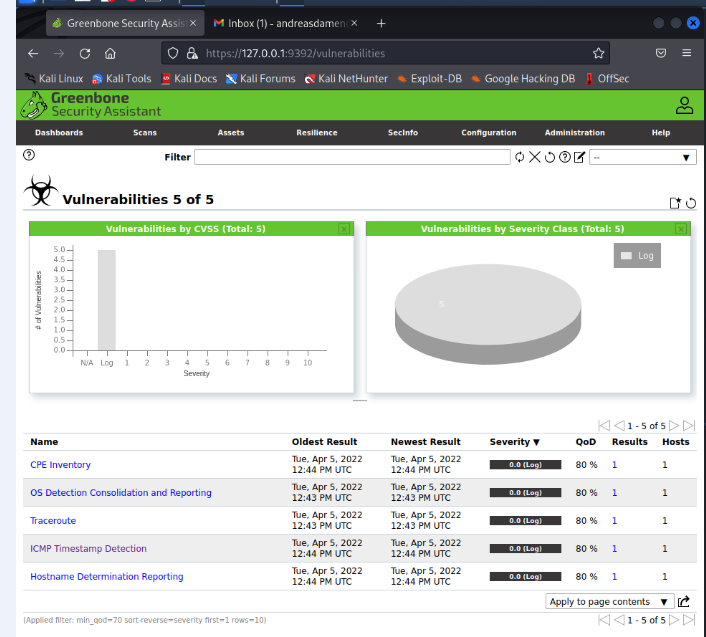
OpenVAS, developed and maintained by Greenbone since 2006, is a vulnerability scanner that encapsulates unauthenticated and authenticated testing capabilities, supports a variety of internet and industrial protocols, and is equipped with a powerful internal programming language for crafting any type of vulnerability test. OpenVAS offers performance tuning options that accommodate large-scale scans.
Key features of OpenVAS:
- Provides both unauthenticated and authenticated testing, covering a range of security assessment needs.
- Supports high-level and low-level Internet and industrial protocols, with broad applicability across different network environments.
- Features performance tuning for large-scale scans, making it suitable for extensive network environments.
- Utilizes an internal programming language, allowing for the implementation of custom vulnerability tests tailored to specific needs.
- Sources its vulnerability tests from a regularly updated feed, ensuring the scanner is always equipped with the latest definitions and checks.
Source: Greenbone

How to Choose Cloud Security Tools
When selecting cloud security tools, here are key considerations to keep in mind:
- Compatibility and integration: Choose tools that seamlessly integrate with your existing cloud infrastructure and security systems. This minimizes disruptions and leverages your current investments. It’s important that the tool complements your cloud service providers and fits well with your IT environment, including compatibility with other security solutions like SIEMs or vulnerability management systems.
- Scalability: The chosen security tools should be able to scale with your cloud environment. As cloud resources are dynamically scaled up or down, your security tools must adapt to changing demands without compromising performance or security.
- Security features: Opt for tools that provide comprehensive coverage across all aspects of your cloud environment, for example CNAPP platforms. This includes workload protection, data protection, threat detection, compliance, and network security. A tool that covers multiple security functions can reduce complexity and improve incident response times.
- Automation and AI capabilities: To enhance efficiency, look for tools that incorporate automation and artificial intelligence. These technologies can help in rapid threat detection and response, reducing the workload on security teams and minimizing human errors.
- Regulatory compliance: Ensure that the security tools comply with the regulatory requirements relevant to your industry. This can include standards for data protection, privacy laws, and industry-specific regulations. Tools that help maintain compliance can save your organization from hefty fines and legal challenges.
- Vendor reputation and support: Evaluate the reputation of the vendor and the support services they offer. Reliable vendor support is essential for troubleshooting, updates, and guidance on best practices. Also, consider the community and ecosystem around the tool for additional resources and integrations.
CNAPP with Aqua Security
Aqua Security enables organizations to unify cloud native application protection and detect, prioritize, and reduce risks across every phase of their software development life cycle.
The Aqua Cloud Native Security Platform is a Cloud Native Application Protection Platform (CNAPP) solution that secures your cloud native applications from day one and protects them in real time. With its fully integrated set of security and compliance capabilities, you can discover, assess, prioritize, and reduce risk in minutes across the full software development life cycle while automating prevention, detection, and response.Learn more about the Aqua Platform
Aqua Cloud Native Application Protection Platform (CNAPP)
Go cloud native with the experts!