Monitor
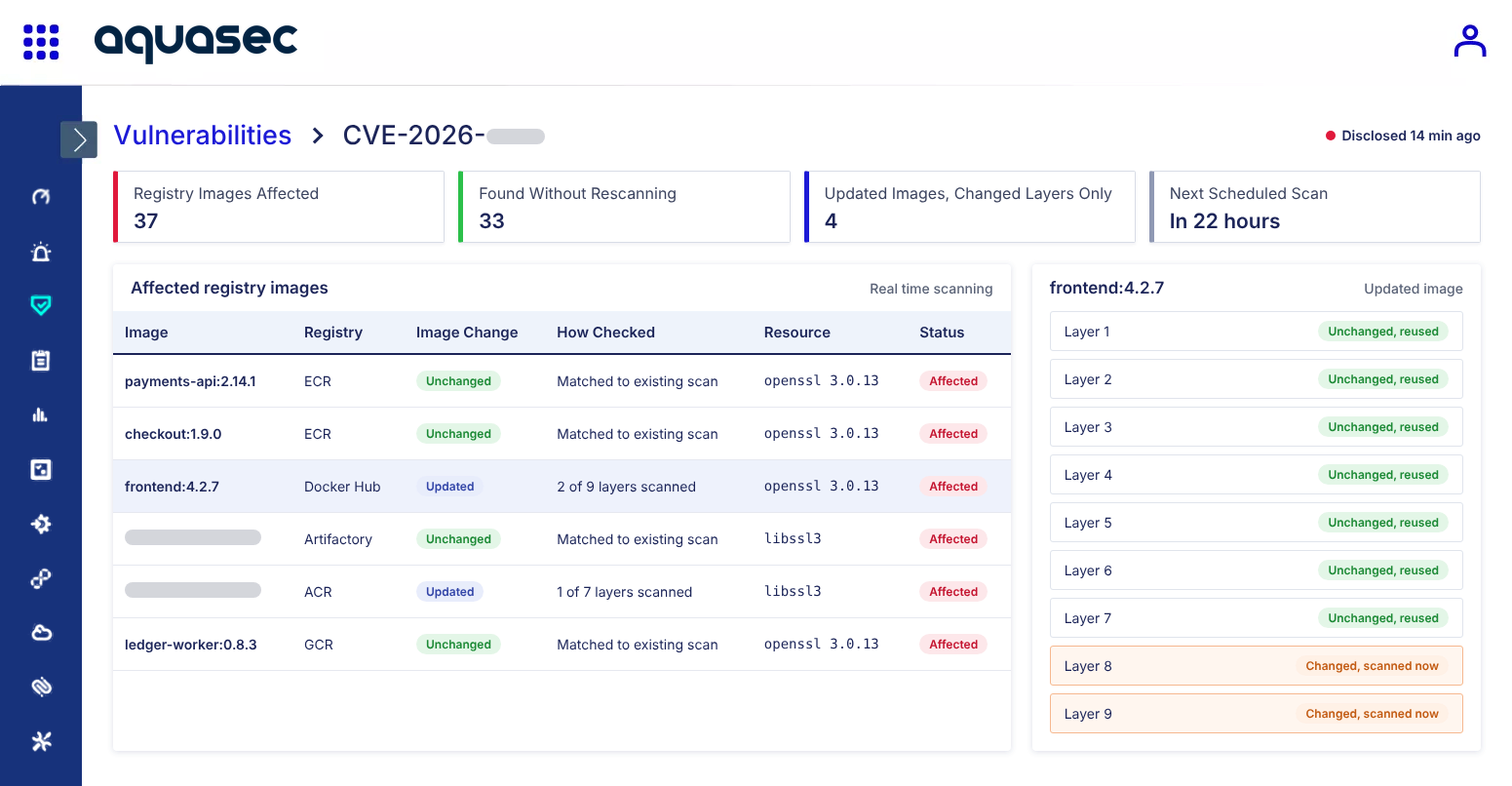
See which images are affected by newly disclosed CVEs without a full rescan, as real-time scanning checks registry images for new vulnerabilities and rescans only changed layers.
Explore MonitorKeep one record of each image from the registry to the running container, so scanning, sandbox testing, deployment decisions and runtime controls all act on the same image.
See which images are affected by newly disclosed CVEs without a full rescan, as real-time scanning checks registry images for new vulnerabilities and rescans only changed layers.
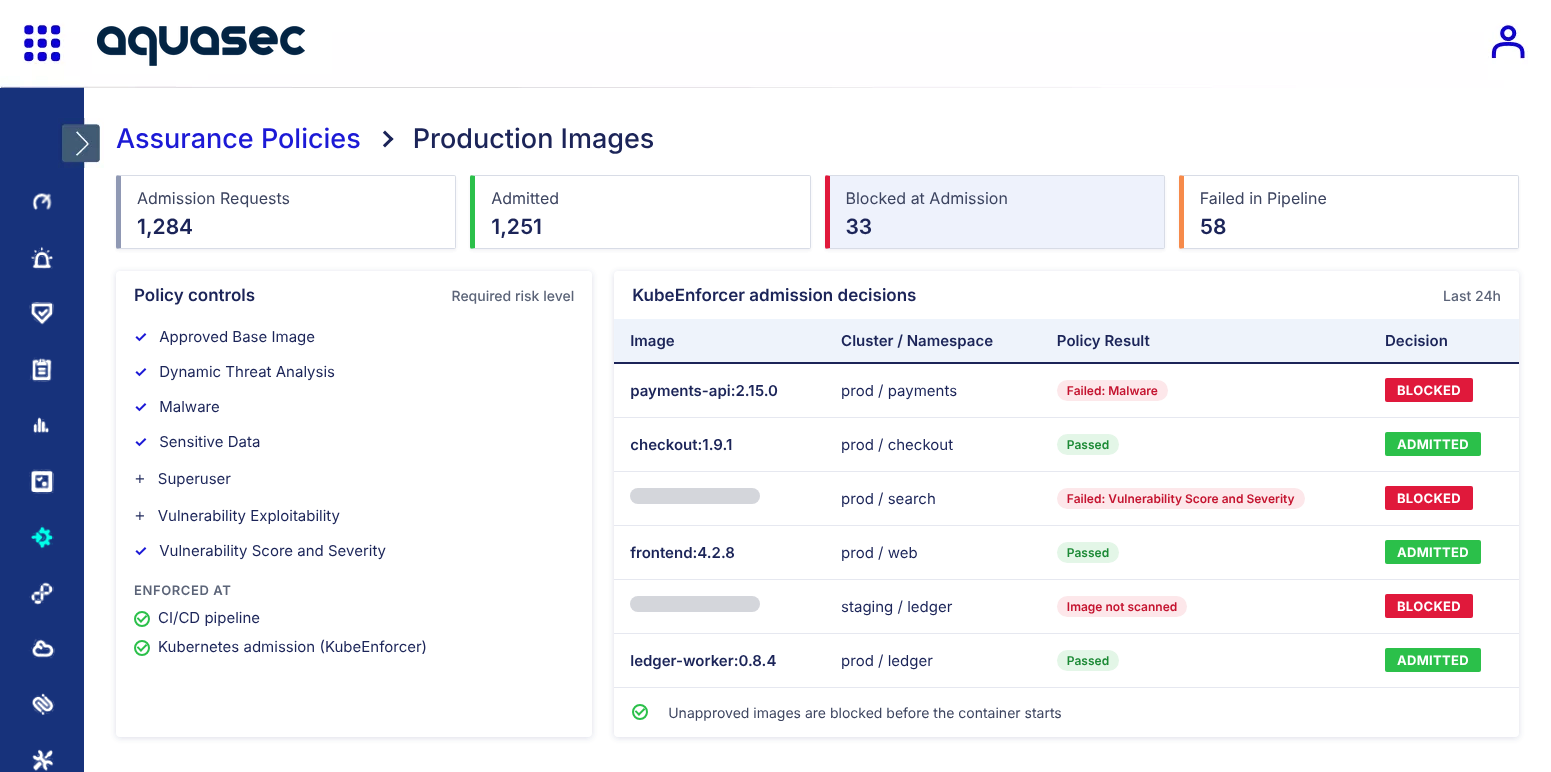
Explore MonitorStop images that fail Assurance Policies before deployment, then apply runtime policies such as Drift Prevention to running containers, denying supported unauthorized actions at the kernel layer.
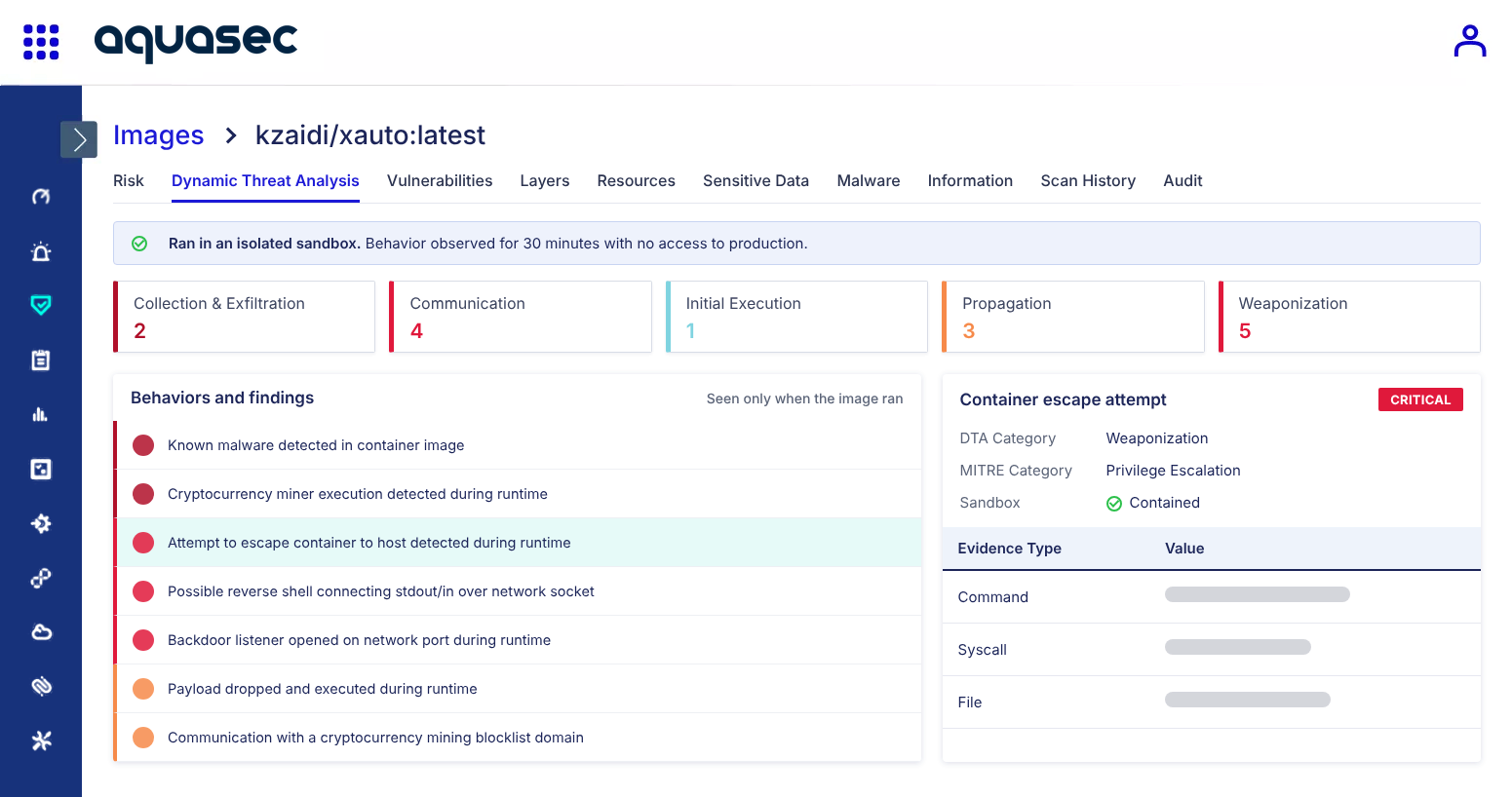
Explore EnforceIsolate suspicious images in a sandbox before deployment to expose malware, cryptominers, backdoors and container escape attempts that static scanning misses.
Explore ContainKnow which registry images a newly disclosed CVE affects without waiting for the next scan cycle. Real time scanning checks unchanged images against new vulnerabilities and scans only the layers that changed in updated images.
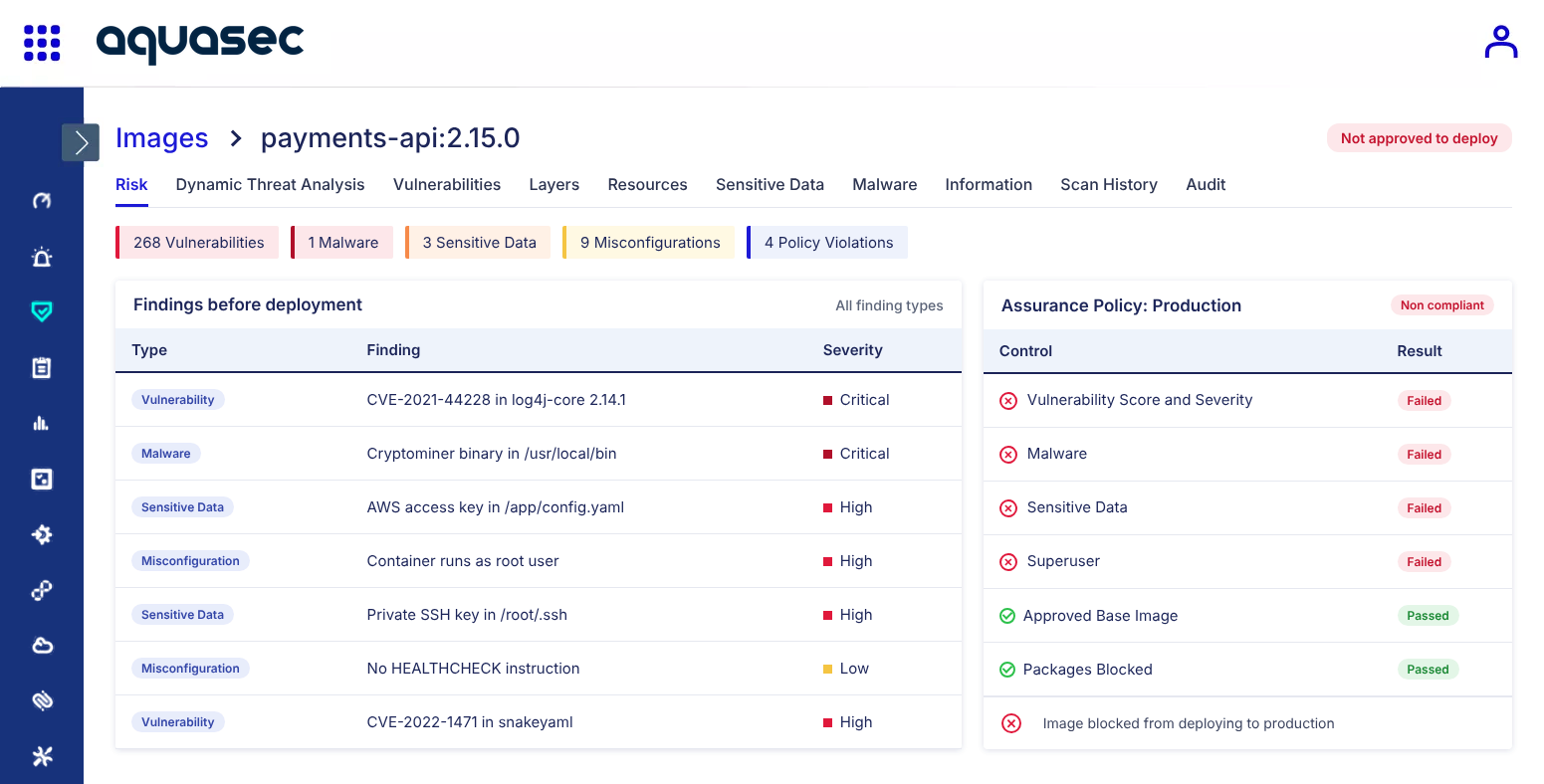
Catch vulnerabilities, malware, embedded secrets and misconfigurations in images before they reach a cluster. Image scanning also flags sensitive data and policy violations, giving Assurance Policies every finding they need to decide what deploys.
Contain malicious images before they reach production. Dynamic Threat Analysis runs selected images in an isolated sandbox and watches their behavior, exposing malware, cryptominers, backdoors and container escape attempts that only appear when the image runs.
Stop images that fail policy in the pipeline or at the cluster. Assurance Policies set the risk level each image must meet, and KubeEnforcer applies them as Kubernetes admission control, so unapproved images are blocked before they start.
Block executables that were not in the image you scanned and approved. Drift Prevention compares each running container to its original image and denies unauthorized binaries at the point of execution, including tools an attacker drops after an exploit.
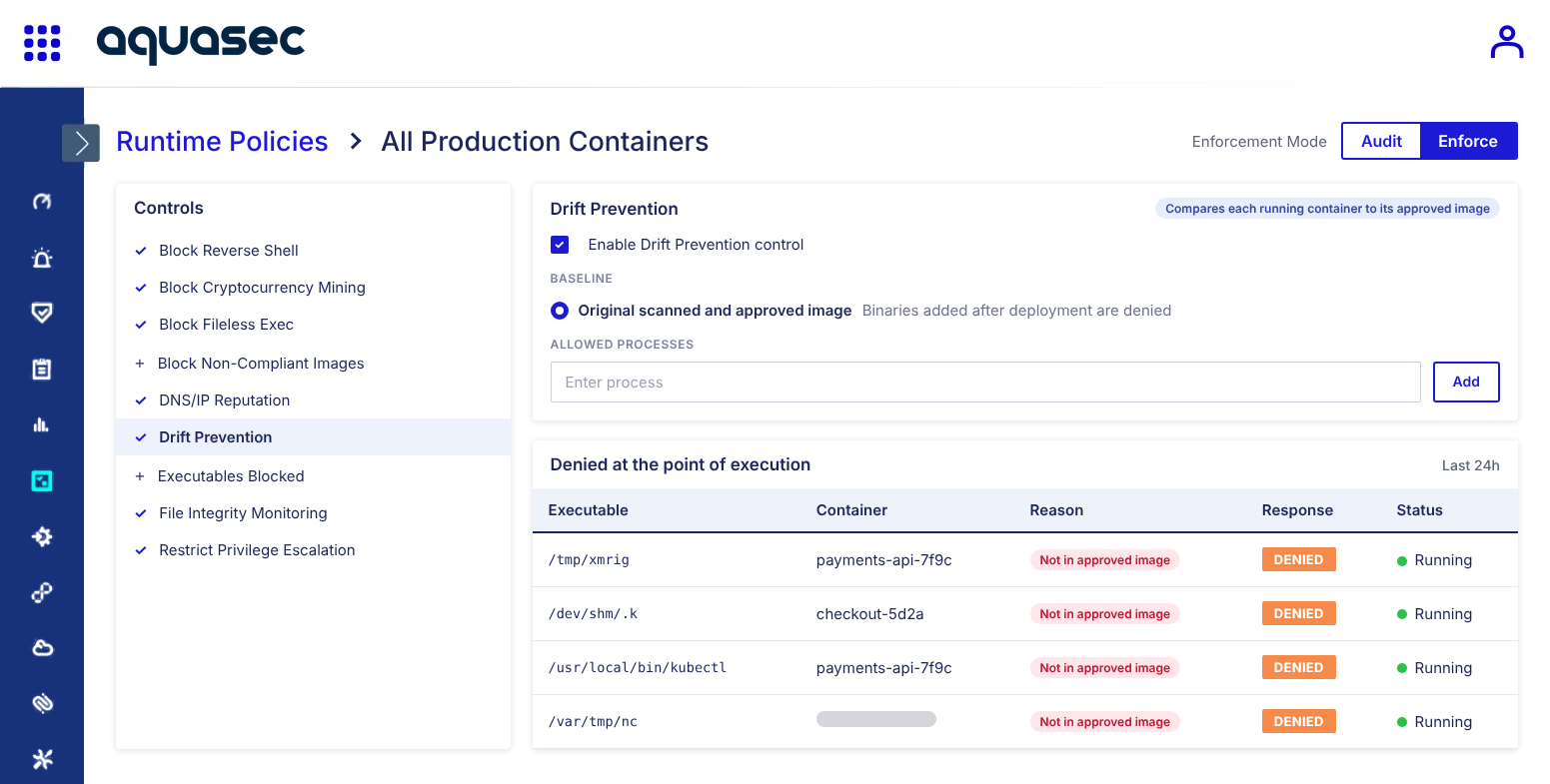
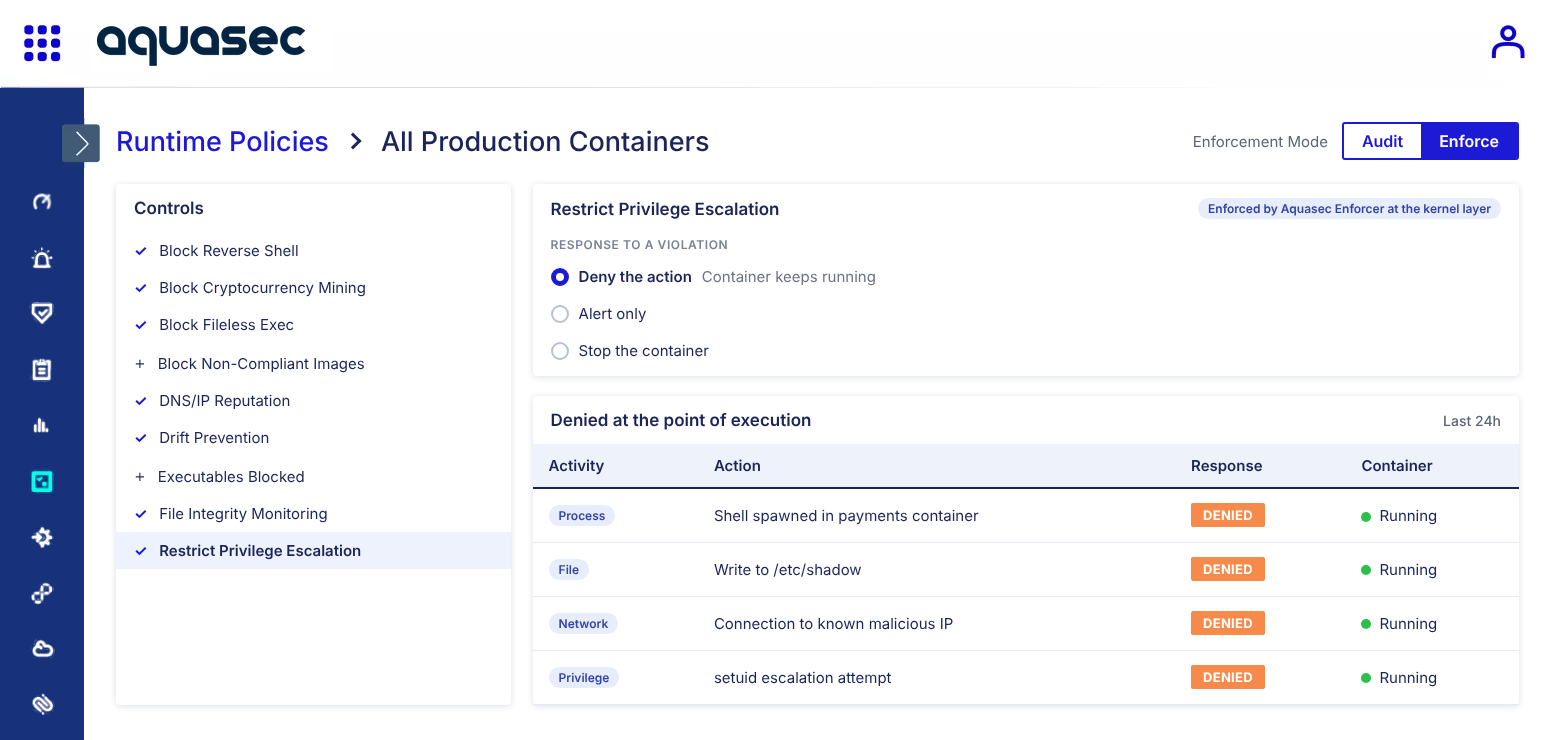
Control process, file, network and privilege activity inside running containers. The Aquasec Enforcer applies runtime policies at the kernel layer, denying supported unauthorized actions at the point of execution without making workload termination the default response.
Real time scanning runs next to your registries with the same architecture in SaaS and fully self hosted deployments, including air gapped environments, and the Aquasec Enforcer protects containers across managed and self managed Kubernetes.
 AWS Fargate
Secure Applications running on AWS Fargate, with the Aqua MicroEnforcer embedded in the containers to ensure that workloads perform their intended function, and detect vulnerable or compromised containers.
Learn More
 AWS Lambda
Protect AWS Lambda Functions, with risk assessment by the discovery of over-provisioned permissions and roles, embedded access credentials, keys and vulnerabilities.
Learn More
 Amazon ECR
Continuously scan container images in Amazon ECR for known vulnerabilities, embedded secrets, OSS licenses, malware, and configuration issues.
 Amazon Elastic Container Service for Kubernetes (EKS)
Protect cloud native workloads on Amazon EKS with full lifecycle security controls, including image scanning, secrets management, and runtime security at scale
Get Aqua from the AWS Marketplace
 Azure Kubernetes Service (AKS)
Protect cloud native workloads on AKS with full lifecycle security controls, including image scanning, secrets management, and runtime security at scale.
Learn More
 GitLab
Automate container image scanning in GitLab CI/CD pipelines to empower DevOps to detect and fix security issues early, and accelerate application deployment.
Read the GitLab Case Study
 Google Kubernetes Engine (GKE)
Protect cloud native workloads on GKE with full lifecycle security controls, including image scanning, secrets management, and runtime security at scale.
Get Aqua from GCP Marketplace
 Harbor
Continuously scan container images in Harbor for known vulnerabilities, embedded secrets, OSS licenses, malware, and configuration issues.
 JFrog Artifactory
Continuously scan container images in Artifactory for known vulnerabilities, embedded secrets, OSS licenses, malware, and configuration issues.
 Oracle Container Engine (OKE)
Prevent untrusted images from running and assure compliant configurations for Oracle Container Engine for Kubernetes. Aqua delivers real-time visualization and actionable insights into the security posture of a Container Engine cluster.
 Red Hat Quay
Continuously scan container images in Red Hat Quay for known vulnerabilities, embedded secrets, OSS licenses, malware, and configuration issues.
 VMware vSphere Kubernetes Service (VKS)
Aqua secures the software supply chain, detects, prioritizes and reduce risks, and stops run-time attacks for applications built and deployed on VMware VKS with a comprehensive cloud native security platform.
Learn More
 Rancher
Protect cloud native workloads on Rancher with full lifecycle security controls that include image scanning, secrets management, and runtime security at scale.
 Kellen Dunham, CTO
Container security protects container images and the running containers built from them. It covers finding risk in images, testing suspicious images, deciding which images can deploy and controlling what containers do once they run. Aquasec covers each stage on one platform, with runtime policy enforced at the kernel layer.
Real time scanning keeps vulnerability results current without rescanning every image on a schedule. Scanners run next to your registries. When a new CVE is disclosed, unchanged images are checked against it without a full rescan, and updated images have only their changed layers scanned. Teams can also trigger a rescan on demand from the console or API.
Image scanning inspects an image’s contents for known vulnerabilities, malware indicators, secrets and misconfigurations. Dynamic Threat Analysis runs the image in an isolated sandbox and watches how it behaves, exposing malware, cryptominers, backdoors and container escape attempts that static analysis can miss.
Assurance Policies define the risk level an image must meet before it can deploy, based on findings such as vulnerability severity, malware, secrets and misconfigurations. Aquasec applies them as acceptance gates in CI/CD pipelines, and KubeEnforcer applies them as Kubernetes admission control, so images that fail policy are blocked before they start.
The Aquasec Enforcer operates inside the workload at the kernel layer, applying runtime policies such as Drift Prevention to deny supported unauthorized actions at the point of execution. Runtime Security extends the same protection to virtual machines and serverless functions.
See runtime control stop an attack the moment it tries to execute.